Answer Engine Optimization: 6 SEO Reflexes That Now Keep You Out of AI Answers
AI answers are halving clicks to websites. Here is a practical Answer Engine Optimization playbook: the six SEO habits to invert so ChatGPT, Perplexity, and Google AI Overviews cite you as the source.
When Google shows an AI summary, people click a link 8% of the time. When it does not, they click 15% of the time. Pew Research measured this across 900 people's actual browsing in March 2025. The AI answer roughly halves the click.
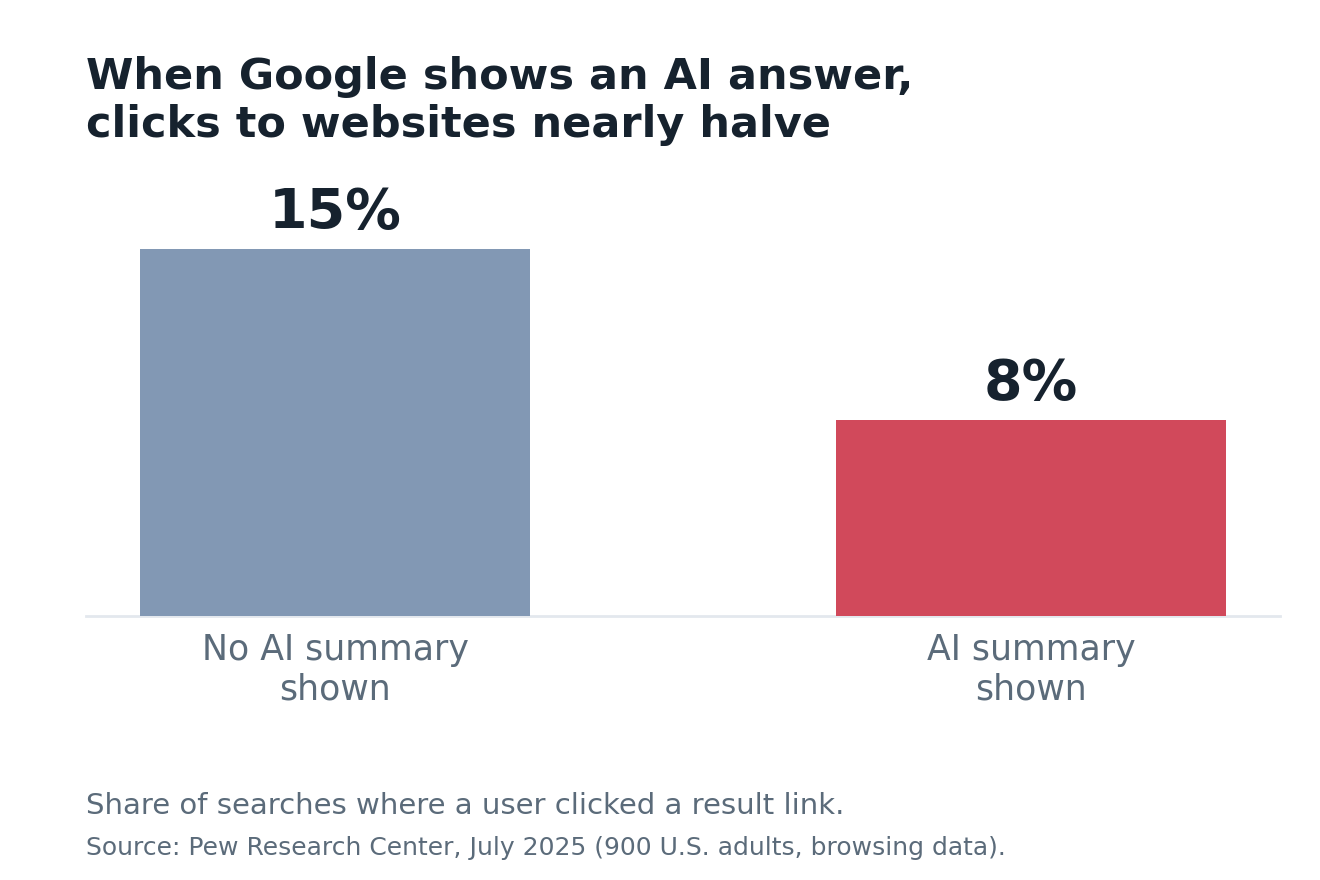
That is the whole story of the next few years of marketing in one number. The traffic is not moving to a different page. It is disappearing into an answer. ChatGPT and Perplexity run the same play on their own turf. The old goal was to rank on page one. The new goal is to be the source the AI quotes.
What is Answer Engine Optimization?
Answer Engine Optimization (AEO) is the practice of structuring your content so AI systems like ChatGPT, Perplexity, Google AI Overviews, and Gemini cite it as a source in their generated answers. Where traditional SEO competes for a ranked link, AEO competes to be quoted inside the answer itself. In practice it means writing extractable, well-sourced, openly-crawlable content that an AI can lift and attribute.
It is generating a lot of noise about a brand new discipline. It is not brand new. Here is the part nobody selling you an "AEO tool" wants to say out loud.
SEO is not dying. It is inverting.
Almost every reflex that won the last decade of search now works against you. The playbook did not get replaced. It got flipped. Once you see it that way, the work is obvious. Here are the six inversions that matter, and what to do about each.
1. Stop writing paragraphs. Start writing answers.
Was: Long, flowing posts that keep a reader on the page. Now: Self-contained answer blocks a machine can lift.
AI systems do not read pages. They extract passages. They lift a self-contained chunk that answers the question and drop the rest. A beautiful 2,000-word essay where the answer is buried in paragraph nine loses to a plain block that states the answer in the first line.
So open every section with the direct answer, then support it. Keep the core answer to 40 to 60 words. Write headings the way people actually ask, "how much does X cost," not "Pricing." If a human can skim one block and get a complete answer, a machine can lift it.
2. Stop stuffing keywords. Start citing data.
Was: Keyword density on the target phrase. Now: Sourced statistics, quotes, and citations.
Princeton and IIT Delhi ran the first controlled study on this, testing nine tactics across 10,000 queries against real AI engines. The three that moved visibility most, each by 30 to 40 percent, were citing sources, adding statistics, and quoting experts. Keyword density, the thing a decade of SEO was built on, was among the weakest levers they tested.
The takeaway is blunt: specificity is what gets quoted. "We are the best" gets ignored. A claim with a real number, a named source, and a date attached gets pulled into the answer. The three winning tactics in that study were the same move in three forms, cite it, quantify it, attribute it. Do that on every claim that matters.
3. Stop selling in your comparisons. Start being fair.
Was: A "you vs competitor" page where you win every row. Now: A balanced table that admits where you lose.
AI models discount comparisons that are obviously rigged. They are pattern-matching for balance, because a balanced comparison is a more trustworthy source. The page that admits where a competitor is stronger is the page that gets cited, and the citation is worth more than the flattering table you wrote for yourself.
Build the honest table. Real criteria, current pricing, the row where you lose included. Trust is the thing being ranked.
4. Stop guarding your domain. Start showing up where AI looks.
Was: Pull traffic onto your own property and keep it there. Now: Be accurate on Wikipedia, present in the right subreddits.
This is the inversion founders resist most. For twenty years the goal was to pull traffic onto your own property and keep it there. Now look at where ChatGPT actually gets its answers.
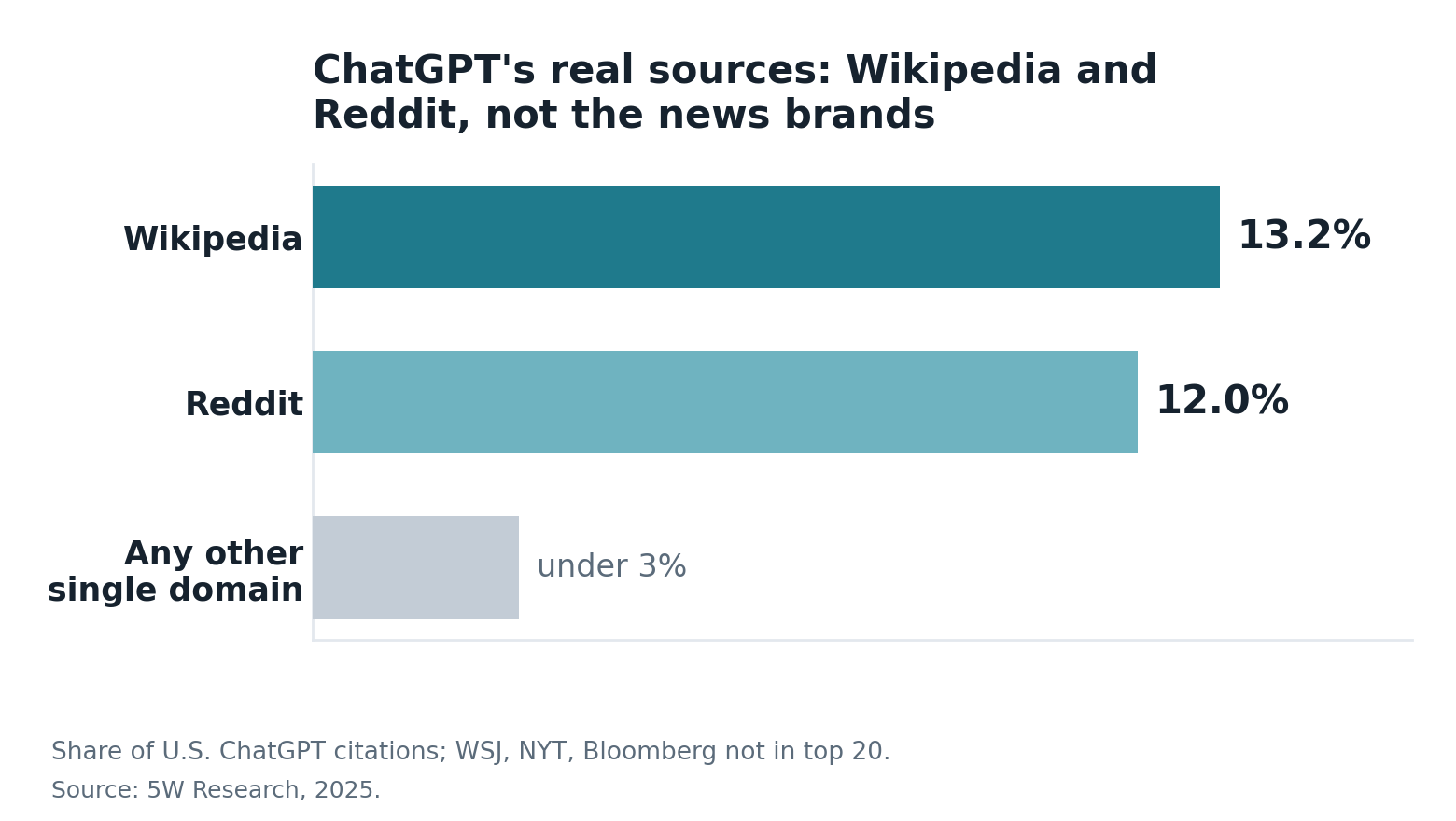
Wikipedia and Reddit together account for more than a quarter of U.S. ChatGPT citations. No other single domain breaks 3 percent. The Wall Street Journal, the New York Times, and Bloomberg do not appear in the top 20. Your company blog is not on that chart, and it is not going to be.
So the work is not only on your site. Make sure your Wikipedia presence is accurate. Answer questions, as a human, in the subreddits your buyers actually read. Get into the third-party roundups and review sites. One accurate Reddit thread can out-cite a month of posting on your own domain.
5. Stop gating and blocking. Start opening the doors.
Was: Best asset behind an email form; crawlers locked out. Now: Open HTML the answer engines are allowed to read.
Both moves make you invisible to AI. Anything behind a gate or trapped in a PDF cannot be read or cited. And if your robots.txt blocks GPTBot, PerplexityBot, ClaudeBot, or Google-Extended, you have quietly opted out of being quoted on those platforms entirely.
Check both today. Open your most authoritative content, keep it in clean HTML, and let the crawlers that feed the answer engines reach it.
6. Measure citations, not rankings.
Was: A rankings dashboard, tracking page position. Now: A monthly log of who gets cited, and where.
Rank position is no longer the score. Citation is. Once a month, run your 20 most important queries through ChatGPT, Perplexity, and Google, and record whether you are cited, who else is, and which page won. A spreadsheet and 30 minutes beats staring at a rankings dashboard that no longer reflects where your buyers get answers.
The takeaway
AEO is not a new skill you have to learn from scratch, and it is not a tool you have to buy. It is the discipline of taking every SEO instinct you built over the last decade and asking whether it still points the right way. Mostly it does not. Answer fast instead of writing long. Prove instead of assert. Compare fairly instead of selling. Live where the models look instead of hoarding traffic. Open instead of gate.
Do that, and your brand becomes the thing the AI says when a buyer asks. That is worth more than any ranking ever was.
Sources
- Pew Research Center, "Google users are less likely to click on links when an AI summary appears in the results," July 2025. pewresearch.org
- Aggarwal, Murahari, et al., "GEO: Generative Engine Optimization," Princeton University and IIT Delhi, ACM SIGKDD 2024 (arXiv:2311.09735). arxiv.org/abs/2311.09735
- 5W Research, "Wikipedia and Reddit Now Drive Over 25% of ChatGPT Citations in the U.S.," 2025. prnewswire.com
Josh Elberg is the founder of Palavir, where he builds production AI and data tools. He writes about wiring real business systems to AI agents without losing control of either.
About the Author
Founder & Principal Consultant
Josh helps SMBs implement AI and analytics that drive measurable outcomes. With experience building data products and scaling analytics infrastructure, he focuses on practical, cost-effective solutions that deliver ROI within months, not years.
Want this for your own business?
The AI Opportunity Audit is a fixed-fee review of your workflows ($2,500 for one workflow, $5,000 for a multi-workflow operation): an AI readiness scorecard, prioritized automation candidates with build estimates and ROI math, and a 90-day rollout plan.
Scoped on a short fit call, then a fixed-fee proposal — no retainer.